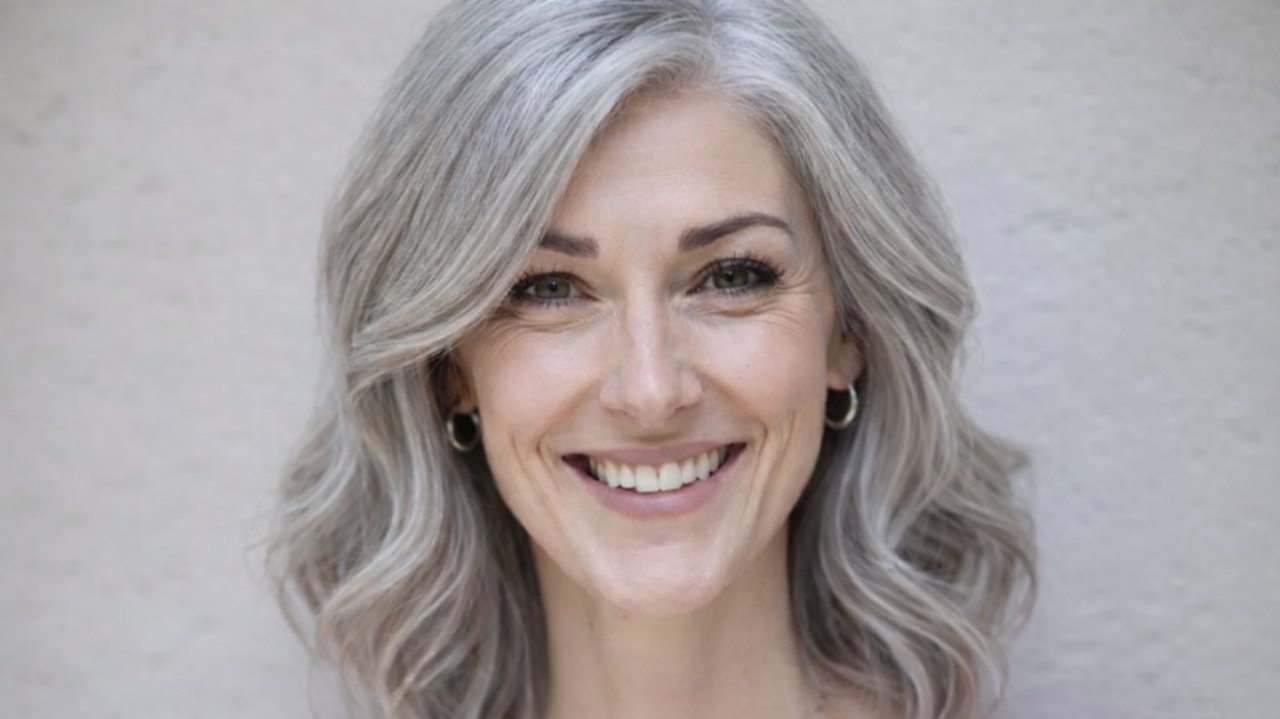
You tilt your head, pull a strand forward, and look closely. One part of you admires the shine.
Another part instantly thinks — “I’m getting older.”

Your hand pauses between the same trusted box dye and nothing at all.
Lately, social media is filled with women who don’t hide their greys, yet somehow look brighter,
fresher, and more confident. No harsh root lines. No flat colour blocks.
Just hair that looks natural and intentional.

Stylists talk about it softly in salons. Brands rename it with gentler language.
TikTok calls it a glow-up without dye. This quiet shift has already begun.

The subtle rise of grey blending and soft ageing
In a busy London salon on a rainy afternoon, chairs are full — but dye boxes remain untouched.
Clients no longer ask to “cover the grey.” Instead, they say things like
“soften it” or “blend it so it looks natural.”
This movement is known as grey blending, often referred to as soft ageing.
Instead of erasing silver strands, colourists work with them.
Fine highlights and lowlights are added in a way that follows the hair’s natural pattern.
Grey isn’t removed — it’s guided.
The result doesn’t demand attention. It quietly suggests healthy hair, balance, and ease.
On social media, the transformations are striking.
Same woman. Same age. A completely different relationship with her reflection.
Recent industry trends show that women aged 35 to 55 are moving away from full-coverage dyes.
Appointments for toning, glossing, and subtle colour refresh services are rising steadily.
A Paris-based stylist shared that grey-blending appointments in her salon have tripled in just two years.
Full root-coverage visits are declining, but spending hasn’t stopped.
It has shifted toward shine, softness, and structure.
Why grey blending often looks younger than full coverage
Full-coverage dye looks flawless for a short time.
Then roots appear, contrast sharpens, and the cycle begins again.

Grey blending works differently. By working with natural colour instead of against it,
the transition stays soft. As hair grows, there is no harsh divide.
Light reflects off different strands, creating depth rather than highlighting regrowth.
There is also a subtle effect on the face.
Flat, opaque colour can harden features.
Multi-tonal hair reflects light around the face,
softening shadows and fine lines.
It’s not about hiding age — it’s about looking rested and balanced.
How modern anti-grey routines actually work
The process usually begins with a pause in full root coverage.
A skilled colourist studies where grey naturally appears —
at the temples, across the crown, or in natural streaks.
Micro-highlights, lowlights, or babylights are then added to mirror that pattern.
It’s closer to editing a photograph than repainting it.
A neutral or cool-toned gloss follows, reducing yellow tones
and giving the hair a smooth, polished finish.
The real advantage appears over time.
Even as the hair grows, it continues to look intentional.
At home, routines become simpler.
Purple or blue shampoos once a week prevent brassiness.
Lightweight masks keep grey strands soft.
Semi-permanent glosses replace harsh box dyes.
Many people notice they need less styling.
Natural texture starts working in their favour.
On busy mornings, that feels like relief.
Are you ready for a softer approach?
- You feel controlled by constant root touch-ups
- Your hair feels dry or fragile from frequent colouring
- You like the idea of grey but dislike a flat salt-and-pepper look
- Full-coverage colour feels more like a disguise than confidence
- You’re curious about what your natural hair really looks like
A new relationship with your reflection
This trend is not just about technique.
It’s about a quiet decision made in front of the mirror —
whether silver is something to erase or something to work with.
Grey blending doesn’t erase time.
It softens its edges.
It allows hair to move, reflect light,
and tell a calmer story without panic appointments every few weeks.
A softly blended haircut often looks fresher than heavy, over-dyed colour.
Somewhere between the salon and the street, something changes.
You stop checking your roots in every mirror.
You start noticing how many others wear that same subtle shimmer.
It no longer feels like defeat.
It feels like ease.
Perhaps this is the real shift —
less hiding, more refining.
Not fighting time, but learning how to move with it.
Key takeaways
- Grey blending uses highlights, lowlights, and toners for a soft, natural look
- Maintenance becomes gentler with glosses, masks, and purple shampoos
- Soft ageing focuses on confidence and working with natural change